

Birman Cat Colors: The Gloves Come First, Then the Twenty Points
The Birman's white gloves are a judged, gene-specific trait scored differently by five registries (20 of 100 points at two of them). The gloves' own genetics, then the twenty point colors.

Published August 21, 2026 4 min read
Contents
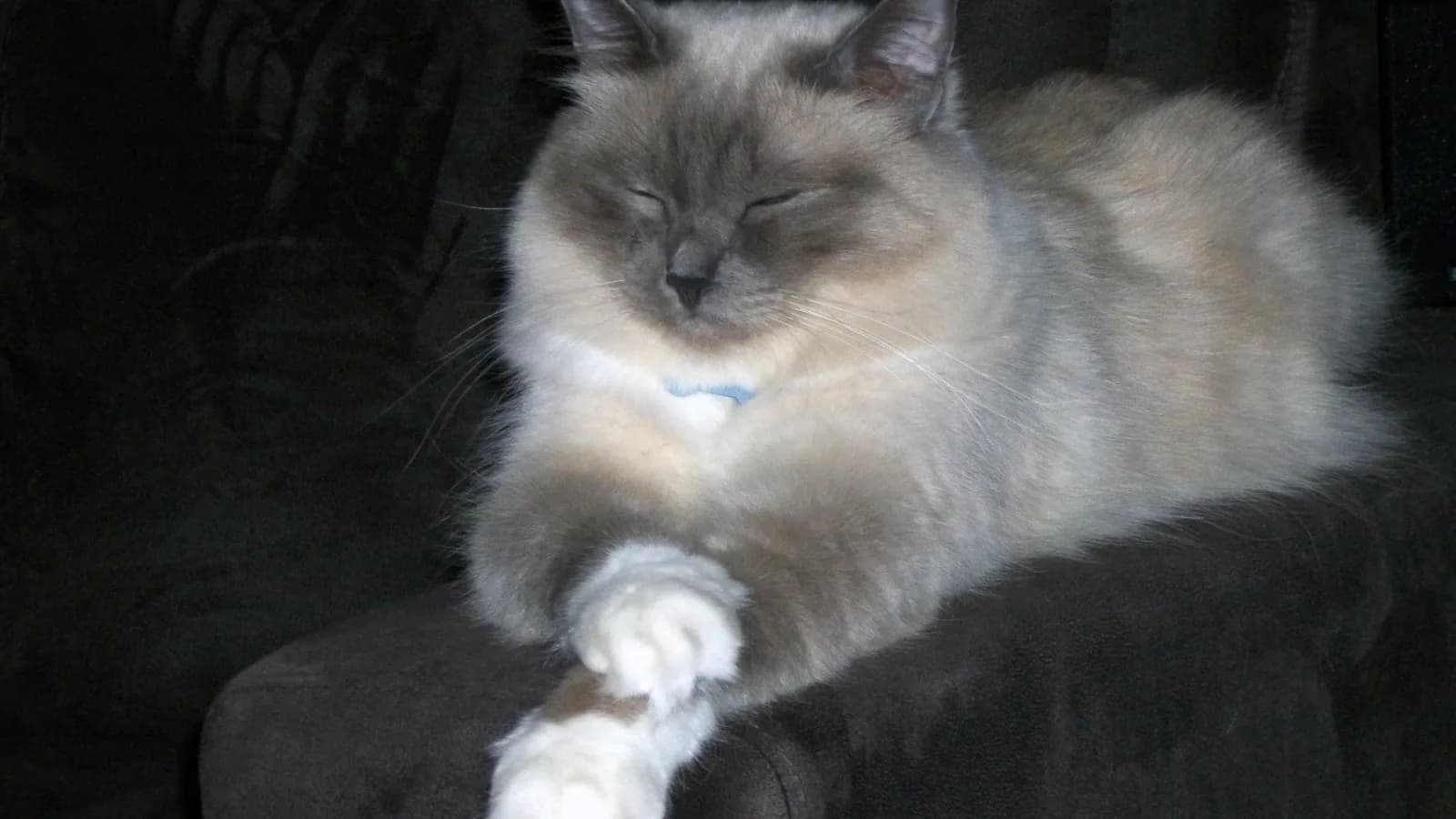
Every pointed breed has colors; only the Birman is judged on its gloves. The four white feet are not a charming accident. They are the breed's signature trait, scored as their own category by every recognizing registry, produced by a gene unique to this breed, and worth a full twenty of one hundred judging points at two registries. This page does the gloves properly first, because they are the story, and the twenty point colors second.
The gloves: one trait, five rulebooks
| Registry | Its own gloving rule | The sharpest detail |
|---|---|---|
| Front gloves end at the third joint | An anatomical landmark, not a vibe | |
| Five labeled paragraphs, to the metacarpal dew pad | Gloves priced at 20 of 100 judging points | |
| White must not pass the paw-and-leg angle | Also bars silver by DNA test, alone among registries | |
| Graded point deductions by fault | A published penalty schedule | |
| A fractional-distance rule | The REVERSED harshest fault: color bleeding INTO the white |
Every registry scores the gloves, and each draws the lines differently, which is exactly the kind of precision the show world argues about. lands the front gloves at the third joint. writes five labeled paragraphs of anatomical precision (down to the metacarpal dew pad) and prices the gloves at 20 of its 100 points. 's rule is that the white must not pass "beyond the angle formed by the paw and leg".
Canada's publishes graded point-deduction ranges by fault. And Australia's uses a fractional-distance rule and reverses everyone's harshest fault: at ACF the worst offense is color bleeding INTO the white, not the white failing to cover the paw. On the back feet, the gloves extend up the hock into the "laces," the detail fanciers photograph first.
The gene behind the gloves
The gloving is an autosomal recessive trait effectively fixed in the breed. All Birmans are, for practical purposes, homozygous for it, which is why every Birman wears the gloves. The gene was characterised by Dr. Barbara Gandolfi's work at UC Davis. One precision matters for anyone comparing breeds: this is NOT the same genetics as a Ragdoll's Mitted pattern, which comes from ordinary white-spotting. 's own words: the Birman's gloving is "not related to the white spotting gene which causes bi-colour cats in other breeds." Same look from a distance, different machinery underneath, and our comparison page makes it the headline distinction.
The twenty point colors
Both and recognize twenty named point colors, independently counted on each registry's own documents: the four classics (Seal Point Birman, Blue Point Birman, Chocolate Point Birman, Lilac Point Birman), the reds and creams, the torties, and the tabby () versions of each. Australia's runs the broadest chart, uniquely including Caramel Point and Apricot Point. Britain adds the chart's sharpest divergence. GCCF's current Registration Policy explicitly BARS silver by DNA test, while acknowledging in its own words that silver "is an accepted colour for Birmans in other organisations". The same coat gene is show-legal in one registry and a registration bar in another.
Reading a Birman's color name
The convention runs color-first: a Seal Point Birman, a Blue Tabby Point Birman. Body color stays pale (the pointed pattern's usual warm-to-cool grading). Points carry the named color, eyes are blue always, and the gloves stay white whatever the points do. A Birman whose "gloves" are missing is failing its own standard. A Birman whose color bleeds into the gloves is failing Australia's hardest.
 The vet's take

Veterinary review
Are you a vet?
Your professional read belongs here: every verified practitioner can leave a note, published once our editors have reviewed it.
Sign in and get your license number verified. We check it in the public register, we never ask for or keep a copy of your diploma, and your number is never published.
Frequently asked questions
What colors do Birman cats come in?
Twenty named point colors at both CFA and GCCF: the four classics, reds, creams, torties and tabby versions, always with blue eyes and the white gloves. Australia's ACF adds Caramel and Apricot points.
Why do Birmans have white feet?
A recessive gloving gene effectively fixed in the breed, characterised at UC Davis, and distinct from the white-spotting that makes other breeds' mitted looks. Every registry scores the gloves as their own judged trait.
What is the rarest Birman color?
No registry publishes registration counts by color, so honest ranking is impossible. The structurally scarce colors are the ones only some registries accept: ACF's Caramel and Apricot points, and silver, which GCCF bars by DNA test while other bodies accept it.
Are Birman gloves the same as Ragdoll mitts?
No: GCCF's own words say the Birman's gloving is not related to the white-spotting gene behind bicolour patterns. The comparison page carries the full contrast.
Do Birman kittens show their gloves at birth?
Kittens are born pale like all pointed cats, with points and contrast developing over weeks and months; the gloves' final edges are among the details breeders watch longest before grading kittens pet or show.
 Community questions
Got a question this page doesn't cover? Ask it: the best ones get published here with their answer.
This is information, not veterinary advice, and it cannot tell you what is wrong with your cat. Our rule is a simple one: if something is wrong with your cat, call your vet, and call an emergency clinic if it is out of hours. Nothing you read here is a reason to wait.
Medical information applies to every reader. Prices, legal duties and common practice do not: unless stated otherwise, they are given for the United States, and they differ in the UK, Canada and Australia, and often between states or provinces. Check with your own vet and your own local authority.
Our sources

Worth keeping a paw on
Pin this guide
So you can find it the day you need it, and share it with someone whose cat does the same thing. One click and it sits in your board.
Pin it on Pinterest
 Purr or Pass
The cat newsletter
Our verified guides, no spam. Unsubscribe in one click.
More Birman guides
The Birman profile →
Birman guide
Birman Kittens for Sale: Prices, Breeders, and the Honest Gaps
Real Birman prices: US catteries clustering $2,200-2,500 above the guides' bands, the UK's rich-clubs-zero-prices pattern, Australia's one-of-eleven listings, and Canada's checked absence.
Read
Birman guide
Birman vs Ragdoll: Two Lookalikes, One Real Genetic Difference
Both are blue-eyed, pointed, semi-longhaired and gentle. The real difference is the Birman's gloving gene, not white spotting at all, plus a size gap narrower than the reputations suggest.
Read
The floor belongs to our members. Keep it kind, links are not allowed, and images go through moderation before anyone else sees them.