

Bombay Cat vs Black Cat: How to Actually Tell Them Apart
Patent-leather coat, copper eyes, surprising weight, a panther sway, and the myth about nose color that even the standards refute. How to tell, honestly.

Published August 21, 2026 4 min read
Contents
Most black cats are not Bombays, by definition: a Bombay is a with papers, not a look. But the LOOK is also specific. The two registries that wrote it down give you a four-point test better than any listicle.
The four-point test, from the standards
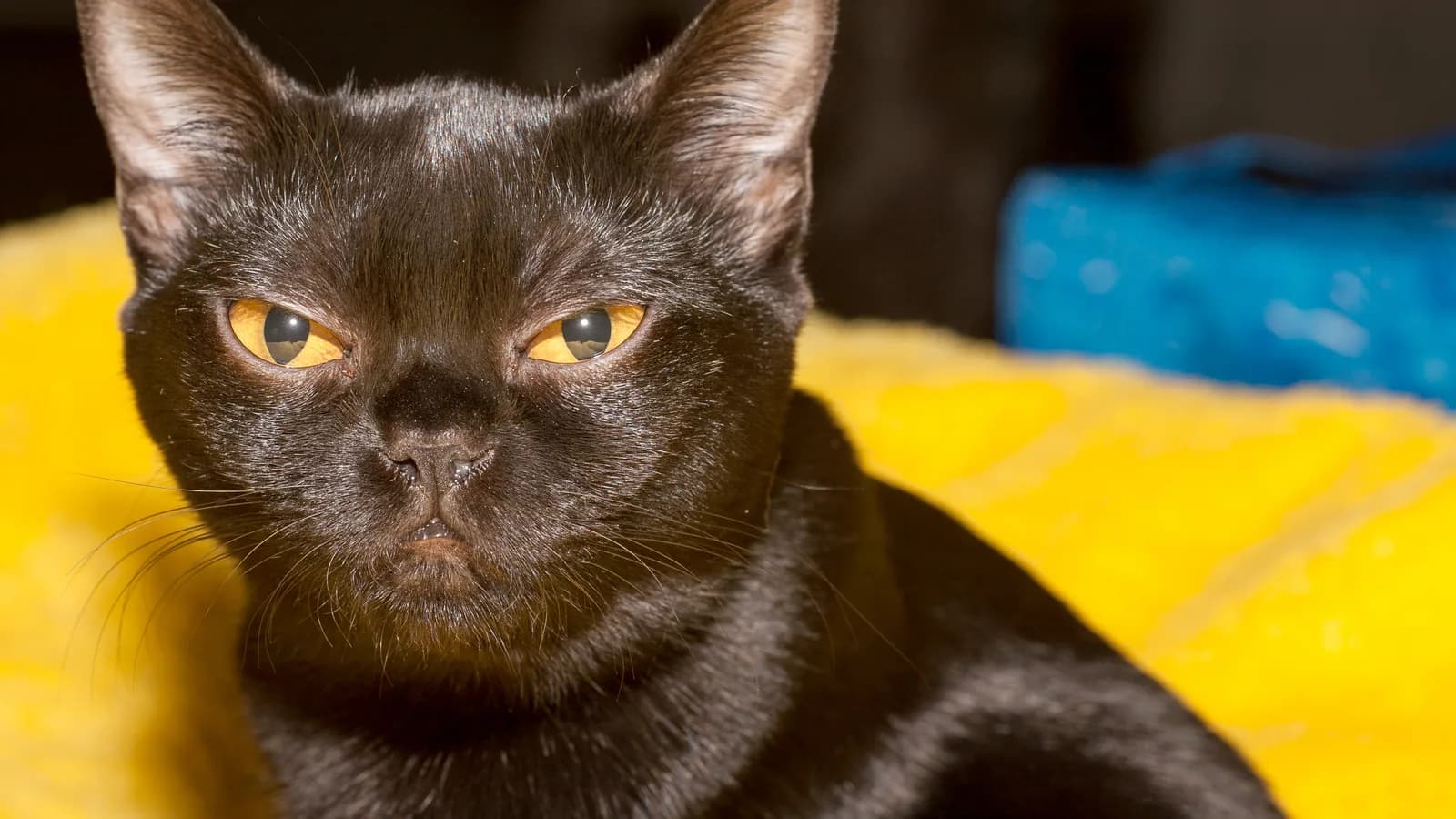
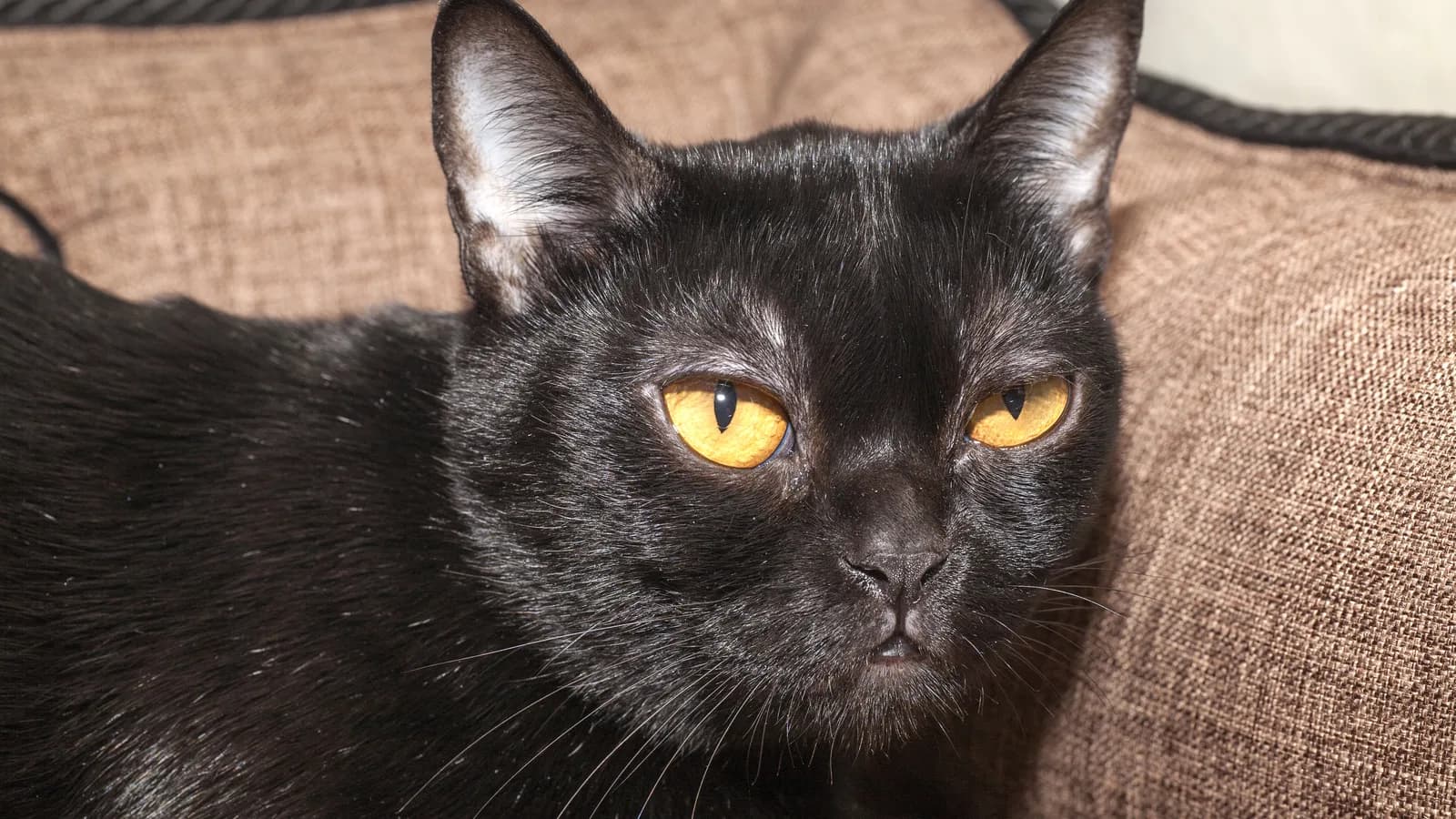
The coat: "patent leather" is the registries' own vocabulary, not marketing. A fine, satin-sheened, jet-black coat, black to the roots. An ordinary black cat's coat reads matte or rusty by comparison, and many carry hidden tabby ghosting in sunlight. The eyes: copper to gold, and this is the breed's signature.
BOTH and score eye color at 10 of 100 points, proportionally more weight than most solid breeds give it. The body: "deceptively heavy for its size" appears across the registry texts. A Bombay in the hands weighs more than the eye predicts. The gait: TICA's own words describe a sway when they walk, "similar to... an Indian black leopard," the whole reason the breed carries its name.
The myth to unlearn: nose and paw-pad color
Competitor pages claim black nose leather and black paw pads mark the Bombay out. The standards refute it. 's own AMERICAN SHORTHAIR standard requires the identical black nose and black paw pads on its solid black cats, with a gold eye that sits inside the Bombay's own accepted range. A solid black American Shorthair passes the nose test perfectly.
That is why 's own "Similar Breeds" field for the Bombay names exactly one breed: the American Shorthair. What actually separates that pair: coat texture and purpose (a hard, weatherproof working coat against a fine satin one), size class ("medium to large" against "medium, never large"), and eye depth (copper preferred against a flat gold floor).
Green eyes, orange eyes, and what they prove
Can an ordinary black cat have copper or orange eyes? Yes. Iris color comes from activity independent of coat-color genes, so copper eyes on a shelter cat are not evidence of hidden Bombay ancestry (and no academic study exists on this specific question: we checked, and publish the absence). The reverse rule is harder. The American Bombay standard DISQUALIFIES green eyes, so a green-eyed "Bombay" without UK paperwork is telling you something. (Britain runs a different story: the British Bombay, a black Asian Shorthair under , normally wears green eyes, per two independent UK sources. The American standard this page describes is the / cat.)
So how rare is a real Bombay?
Rare enough to make the papers the point, and the registries' own dated counts say so plainly. 's own 2013 breed-section poll put Bombay at 1,080 of 427,593 cumulative registrations since 1979: one quarter of one percent. 's own 2023 statistics recorded 10 Bombay registrations that year, ranking it 52nd of 59 breed codes. Both numbers carry their dates because both are snapshots, not today's census. The practical translation: if a listing offers a "Bombay" without registration papers, you are buying a lovely black cat, at a black cat's price (the price page carries what papers cost).
And the Burmese, in one paragraph
The Bombay's parent breed question earns exactly this much. The American Bombay was created from Burmese-by-American-Shorthair crosses, keeps the Burmese's compact heft, and is bred to one color the Burmese standard does not carry (jet black against the Burmese's sable-family coats). It is a sibling question with almost no search audience, so it lives here rather than on its own page.
The four-point test on one card
| Check | Bombay | Ordinary black cat |
|---|---|---|
| Coat | Patent-leather satin, black to the roots (the registries' own words) | Matte, rusty in sun, often ghost-tabby |
| Eyes | Copper to gold: 10 of 100 points at BOTH US registries; green disqualifies | Any color, green common |
| Weight | Deceptively heavy for its size, across the registry texts | As it looks |
| Walk | 's own words: a sway like an Indian black leopard | A walk |
| Nose and paw pads | Black, and NOT a distinguisher: a black American Shorthair has the same | Usually black too |
 The vet's take

Veterinary review
Are you a vet?
Your professional read belongs here: every verified practitioner can leave a note, published once our editors have reviewed it.
Sign in and get your license number verified. We check it in the public register, we never ask for or keep a copy of your diploma, and your number is never published.
Frequently asked questions
Are all black cats Bombay cats?
No, by definition: Bombay is a pedigree, not a color. The registries' own dated counts (0.25% of TICA's cumulative 2013 registrations; 10 FIFe registrations in 2023) make it one of the fancy's smaller breeds.
How can I tell if my black cat is a Bombay?
Without papers you cannot, formally. The four-point look test: patent-leather satin coat black to the roots, copper-to-gold eyes, surprising weight in the hands, and the sway in the walk. Missing the papers, it is a black cat that passes a look test.
Do black noses and paw pads prove a Bombay?
No: CFA's own American Shorthair standard requires the identical black leather on its solid blacks. The nose proves the coat color, nothing more.
Can a Bombay have green eyes?
Not the American (TICA/CFA) Bombay: green disqualifies. Britain's separate British Bombay line, a black Asian Shorthair under GCCF, normally has green eyes, per UK sources.
 Community questions
Got a question this page doesn't cover? Ask it: the best ones get published here with their answer.
This is information, not veterinary advice, and it cannot tell you what is wrong with your cat. Our rule is a simple one: if something is wrong with your cat, call your vet, and call an emergency clinic if it is out of hours. Nothing you read here is a reason to wait.
Medical information applies to every reader. Prices, legal duties and common practice do not: unless stated otherwise, they are given for the United States, and they differ in the UK, Canada and Australia, and often between states or provinces. Check with your own vet and your own local authority.
Our sources

Worth keeping a paw on
Pin this guide
So you can find it the day you need it, and share it with someone whose cat does the same thing. One click and it sits in your board.
Pin it on Pinterest
 Purr or Pass
The cat newsletter
Our verified guides, no spam. Unsubscribe in one click.
The floor belongs to our members. Keep it kind, links are not allowed, and images go through moderation before anyone else sees them.